

Blog
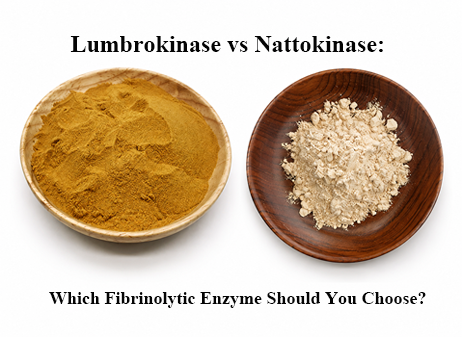






Lumbrokinase vs Nattokinase: Which Fibrinolytic Enzyme Should You Choose?
2026-06-10
As the global population ages and the incidence of cardiovascular disease continues to rise, natural, safe, and orally administered fibrinolytic enzymes are becoming a key growth area in the dietary supplement industry. Consumers are increasingly favoring natural products suitable for long-term use with fewer side effects—either as alternatives to or supplements for traditional anticoagulant medications.
Oral fibrinolytic enzymes, notably lumbrokinase and nattokinase, are seeing expanding market demand due to their well-defined mechanisms for supporting blood circulation and cardiovascular health; they are particularly prominent in the functional food and health supplement sectors across North America, Europe, and the Asia-Pacific region.
Lumbrokinase vs Nattokinase: Source and Molecular Classification
Lumbrokinase is a group of fibrinolytic enzymes derived from earthworms, consisting of six distinct serine protease isoenzymes found in species such as Lumbricus rubellus and Pheretima aspergillum. Thanks to its potent fibrinolytic activity and ability to inhibit platelet aggregation, lumbrokinase has been clinically proven effective in the prevention and treatment of cardiovascular diseases.
Nattokinase is produced through the fermentation of non-GMO soybeans using Bacillus subtilis var. natto and is classified as a single serine protease. As the most active component of natto, nattokinase (NK) exhibits powerful fibrinolytic activity alongside blood pressure-lowering, anti-atherosclerotic, lipid-lowering, anti-platelet aggregation, and neuroprotective effects.
Lumbrokinase vs. Nattokinase: Dissolving Blood Clots
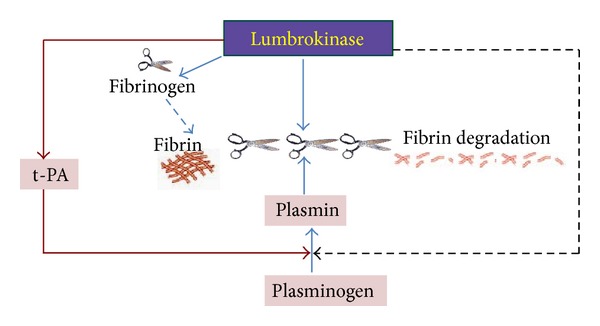
The thrombolytic mechanism of lumbrokinase is highly fibrin-specific. It directly degrades cross-linked fibrin to rapidly dissolve blood clots; simultaneously, it possesses intrinsic tissue-type plasminogen activator (t-PA) activity, allowing it to directly activate local plasminogen at the site of the clot and bypass multiple biochemical steps.
Unlike clinical thrombolytic drugs, lumbrokinase does not convert plasminogen into plasmin; consequently, it does not induce systemic hyperfibrinolysis and carries a lower risk of bleeding. In addition, it inhibits platelet aggregation, exhibits high thermal and alkaline stability, and is suitable for oral administration.
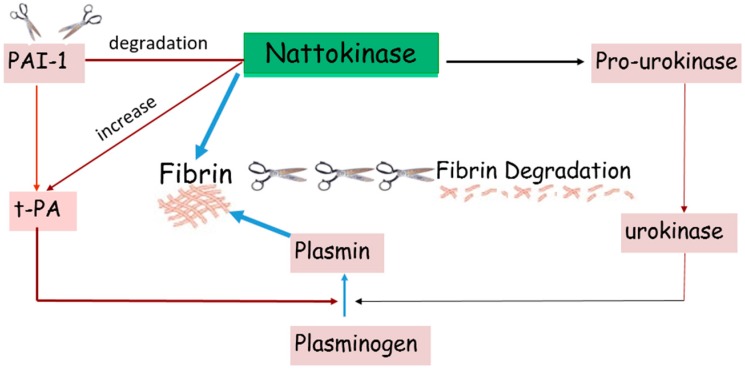
Nattokinase employs a multi-targeted mechanism for thrombolysis. It directly hydrolyzes fibrin and plasmin substrates to dissolve thrombi; simultaneously, it converts endogenous single-chain prourokinase into two-chain urokinase (uPA) and degrades plasminogen activator inhibitor-1 (PAI-1). By reducing the inhibition of tissue-type plasminogen activator (t-PA), it increases t-PA levels and enhances the body's endogenous fibrinolytic activity.
Unlike clinically common thrombolytic agents such as t-PA, nattokinase does not cause significant bleeding side effects and can be administered orally.
Lumbrokinase vs. Nattokinase: Specification Standards
Lumbrokinase activity is typically quantified in International Units (IU) or specific activity units (U/mg). However, the lack of a unified international activity standard, relatively limited clinical dosage research, and lower batch-to-batch stability inherent in its nature as a multi-enzyme complex pose challenges for precise dosage control and regulatory compliance.
Nattokinase utilizes standardized FU units, and its clinically effective dosages have been thoroughly validated (e.g., 10,800 FU/day for anti-atherosclerosis effects). It demonstrates a clear dose-response relationship and consistent batch quality, facilitating large-scale production and formulation design; mainstream commercial specifications typically range from 5,000 FU/g to 50,000 FU/g.
Lumbrokinase vs. Nattokinase: Safety
Compared to lumbrokinase, nattokinase offers significant safety advantages. It has been validated through GLP-compliant toxicology studies and shown to be non-mutagenic, with a strong track record of human use spanning decades globally. Furthermore, advanced purification processes allow for the complete removal of Vitamin K2, thereby eliminating interference with anticoagulant therapy.
In contrast, lumbrokinase is derived from animal sources, carrying a higher risk of impurities and potential gastrointestinal discomfort; its theoretical advantage of "not activating plasminogen" shows no significant difference in actual oral application. Overall, nattokinase offers more robust safety data and a more controllable production process, making it better suited for long-term daily health maintenance and compliance with export regulations.
Both nattokinase and lumbrokinase share a potential side effect of increased bleeding tendency and have clear contraindications for use with anticoagulants like warfarin and aspirin; concurrent use requires strict monitoring. However, both exhibit excellent hepatic safety, with no evidence of additional metabolic burden on the liver or reported hepatotoxicity, making them suitable for long-term oral administration.
Lumbrokinase vs. Nattokinase: Formulation Suitability
Both nattokinase and lumbrokinase are orally absorbable, acid-resistant, and enter the intestine in an active form. Clinically, nattokinase focuses on daily cardiovascular health and long-term thrombosis risk prevention, whereas lumbrokinase is used as an adjunct therapy for conditions such as cerebral infarction and coronary heart disease.
Internationally, natto extract nattokinase powder is widely distributed as a dietary supplement in markets like Europe, the US, and Japan, backed by mature regulatory frameworks (e.g., FDA GRAS, EU Novel Food status); lumbrokinase is available as a health product in North America and Japan, though its regulatory pathways are relatively limited.
About Kintainutri®
Kintainutri® specializes in the R&D and production of high-purity nattokinase ingredients. Our products range from 5,000 to 50,000 FU/g, feature excellent batch consistency, and meet international certifications such as ISO, GMP, Kosher, and Halal. We provide a stable supply chain, comprehensive technical support, and flexible OEM/ODM services to help global brands create scientifically sound, safe, and compliant cardiovascular health products.
Our natto extract nattokinase powder addresses a common industry challenge, the high Vitamin K2 content found in crude natto fermentates, by utilizing an advanced purification process to remove Vitamin K2 and prevent interference with blood coagulation. Please contact Kintainutri® for procurement inquiries.